Senior Students & Emerging Technologies


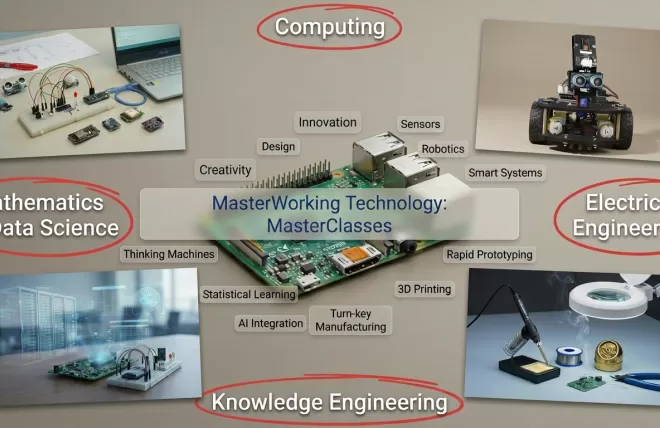
There is an exciting space between Electrical Engineering, Computing, Data Science, and Mathematics from which new technologies continue to emerge and whose applications are driving advancement in all areas of human activity (see Figure 1 below). We can call this space 'ubiquitous computing' or 'knowledge engineering'.
The key capabilities of ubiquitous computing are:
- real-time acquisition 'rich data' combined from multiple sensor inputs + user behaviour
- analysis of multi-layered data with contextual interpretation
- intelligent response
These capabilities have been enabled by the rise of small, low-cost energy efficient sensors and microcontrollers, many with integrated wireless, GPS, and inertial measurement units (IMUs), connected to high-speed databases in the cloud.
For individuals or teams that are able to bridge the disciplines involved, the potential for compelling applications is limited only by the imagination!

Figure 1. The integration of cross-disciplinary areas, coming out of traditional science and technology disciplines, is driving the rise of new technologies applied to all areas of human activity.
Outlook & Opportunities
With the emergence of AI Agents and models released to the public in late 2022, the trends are certain to accelerate.
Building knowledge and strengthening capability in these areas will differentiate those who understand and can leverage these technologies, from those getting left behind, with the accompanying implications on social mobility, generational trends, and the further stratification of society.
The long-standing challenge of governments & civil society to ensure equitable access to this knowledge and these capabilities, will become even more urgent. The disruptive implications for education at all levels (primary, secondary, undergraduate, and post-graduate) will reward those with initiative and the willingness to learn. The cooling job market will favour those with access to experienced mentors and those able to combine innovation with entrepreneurism.

Expand Your Horizons
For students studying the traditional subjects, be on the lookout for every opportunity to stretch into the cross-curricular areas. For those studying entrepreneurship or business, take the opportunities to get hands-on with a wide array of technologies. The future of applied science and technology has never been more exciting for those who are able to participate!

Figure 2. The traditional courses of study (shown in blue in the outer ring), with the new capabilities driving emerging technologies as part of a ubiquitous computing trend.
What classes are offered for senior students (A-Level or University)?
For senior students, the pathway is through one or more foundation knowledge courses followed by applications.
The first course with us is a foundational knowledge course chosen based on interest:
- "Electronics, Sensors & Microcontrollers" for those with Hardware/Software interest
- "Computing from the Ground Up" for those with Computing/Software interest
Application courses can be taken after one or more foundational knowledge courses, based on the participant's interest.
We currently offer the following six application tracks:
From the Hardware/Software foundation, we offer:
- INTELLIGENT SYSTEMS
- ROBOTIC GUIDANCE & CONTROL
- SOUND EFFECTS (SFX) GENERATION & DIGITAL MUSIC
From the Computing/Software foundation, we offer:
- LANGUAGE DESIGN FROM THE GROUND UP
- ECOCOMPUTING
Either of the foundation courses can lead to:
- EMBEDDED GRAPHICS

Learn about our A-Level & University-age programmes
- University friendly times (7-9.30pm) during academic year
- Intensive programmes over term & summer breaks
- Guided research experiences
SIGN UP TODAY!
- Introductory offer: 20% OFF first course
- Sibling & Referral discounts
- Taster sessions can be arranged (space permitting)
- Maximum 6 participants per session. Reserve your place today!